Nursery Cryme
A comparison of five releases of this 1971 album from first pressing vinyl to a 2026 Atlantic 75 SACD.

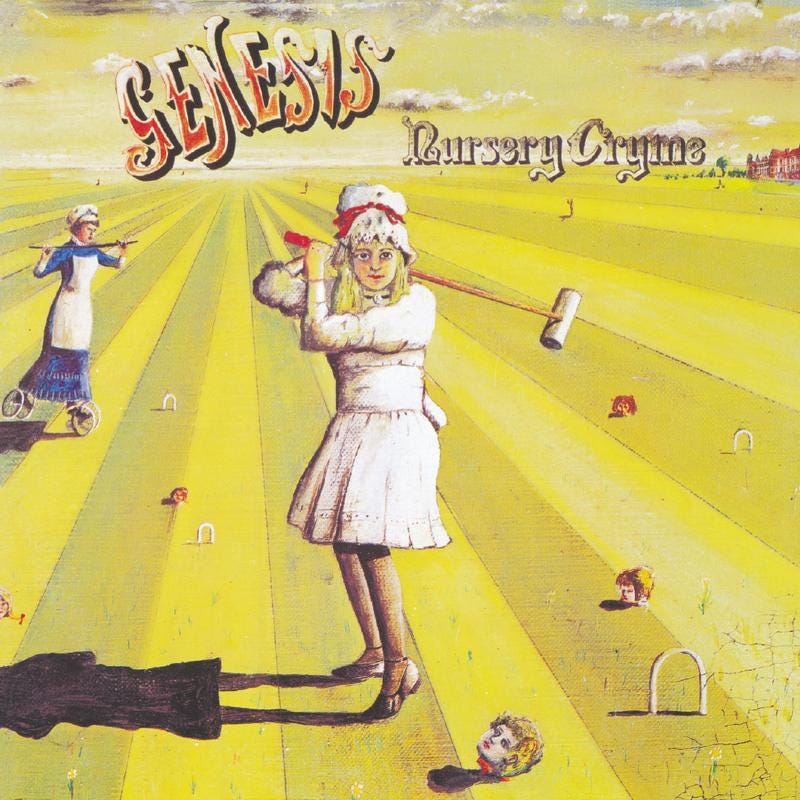
I currently own five copies of the album Nursery Cryme by Genesis. They are:
the 1972 U.S. vinyl first pressing LP by Monarch Records from Charisma Records [CharismaLP],
the 1982 reissue cassette from Atlantic Records [AtlanticCAS],
the 1994 Definitive Edition Remaster compact disc remastered by Nick Davis and Geoff Callingham from Atlantic Records [AtlanticCD],
the 2008 SACD/PAL DVD release re-mixed and re-mastered by Nick Davis from Charisma Records [CharismaSACD], and
the 2026 Atlantic75 SACD remastered by Chris Bellman from Craft/Rhino/Analogue Productions [AtlanticSACD].
I first purchased this album around 1987-88, if memory serves. I was already pretty deep in my journey into the Genesis catalog at that point. I know already had Invisible Touch, Genesis, Abacab, Duke, and Selling England By The Pound. The 1986 MTV documentary From The Beginning had already appeared (owing to the U.S. chart success of Invisible Touch, GTR, and Sledgehammer that year). That laid out the basic timeline of the band up to that point, though it was hardly exhaustive. It started by talking to Tony, Mike, and Peter about meeting at Charterhouse and then briefly mentioned From Genesis To Revelation via a TV interview quote with Jonathan King. It skipped over Trespass entirely and then talked about bringing Phil and Steve on board. My memory is that one of the five (probably Peter) says something about how Nursery Cryme was the album where they started to sound like Genesis, but I can’t find it on the VHS bootleg on YouTube. I remember buying the cassette tape knowing that the album was a milestone.
My first reaction to this album was (as with Foxtrot) one of relative ambivalence. That’s not down to the material on the album; the songs here cover a wide range of topics and many of them are good. There are the live powerhouses, The Musical Box (which inspired the title of the album) and The Fountain of Salmacis. There is wry humor and social commentary in Harold The Barrel. There are more acoustic and folkloric songs like Harlequin and Seven Stones that sound more like the material on Trespass. There is also Phil Collins’ first outing as lead vocalist on For Absent Friends, a short collaboration largely between the “new boys in the band” (Phil and Steve.) The utter English-ness of this album makes it an absolute favorite of many Genesis fans. That was not me, at least not for a long time.


My oldest memories of [AtlanticCAS] can be summed up with the word “murky”. I’ve come to appreciate that Nursery Cryme is an album that can be somewhat demanding. It is both rather loud and quite delicate, depending on the track. Peter Gabriel goes from screaming “Why don’t you touch me, touch me, touch me now, now, now, now” to Phil gently singing “Sunday at six, they close both the gates” in the space of less than 20 seconds. When the volume highs are that high and the volume lows that low, fidelity and detail matter.
Those were not things that a Sony Walkman was providing from this tape in 1987. There was hiss and motor noise. The cassette said it had Dolby B Noise Reduction, but it was questionable if it helped. The music felt buried, or at the very least, sleepwalking. It was difficult to embrace an intricate recording when its details feel barely audible.
The packaging here is bare bones. The outside of the J-card has the cover art, the song titles, and the producer credit. The inside of that same card repeats the song titles and then provides the album production credits.
That’s not much, but it’s better than what the bulk of the Genesis back catalog provided in the 1980’s. Of the Genesis cassettes that I own made prior to 1989, only six provide this level of detail: Nursery Cryme, Foxtrot, Live, Abacab, Genesis, and Invisible Touch. The inside of the J-cards for all the other albums are blank.
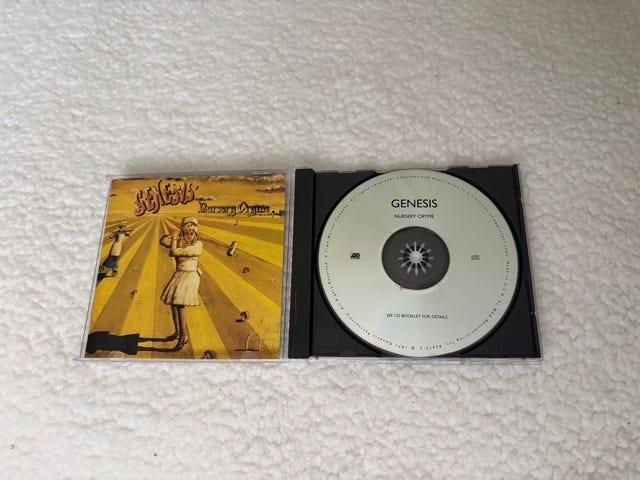
[AtlanticCD] was one of the later upgrades to Definitive Edition Remaster series. I had the 1987 CD release, but many of my impressions from [AtlanticCAS] lingered. That first CD didn’t seem like much of an improvement. It was almost a pro forma purchase to complete the set of post-Trespass to pre-Genesis albums. [AtlanticCD] was no revelation either, and it hasn’t been played much in 30+ years I owned it.
This CD was a huge upgrade in terms of packaging from either of the older copies I’d owned. The 1987 CD provided a single fold booklet. The inner pages listed the song titles and showed a black and white enlargement of the Georgian house on the back of the LP jacket. The back of the booklet showed the production credits. The [AtlanticCD] booklet provided all the lyrics and some of the art from the album gatefold on the inside. Outside, it reproduced nearly all the art from the [CharismaLP] jacket.
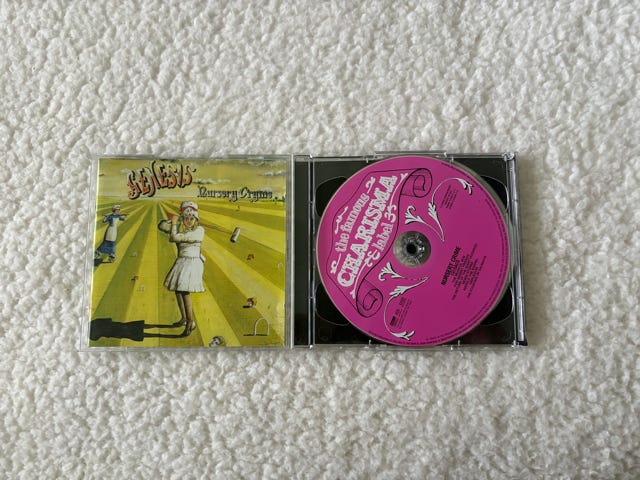
I’m sure that [CharismaSACD] was also something of pro forma purchase, though I was hopeful that the Nick Davis re-mix would finally help resolve some of the fidelity problems. Looks like I purchased it from Amazon in 2010. It’s the European version with the PAL DVD. I must have discovered that my OPPO Blu-ray player could handle that format by then. In contrast, I sought out import NTSC DVD versions of Wind & Wundering and A Trick Of The Tail two years earlier.
This is the disc that finally reproduced all the artwork from the [CharismaLP] gatefold. There is a full set of album lyrics in a multipage booklet. The lyrics and the artwork are split up differently to accommodate the reduced page size of the booklet, but it appears to all be there.
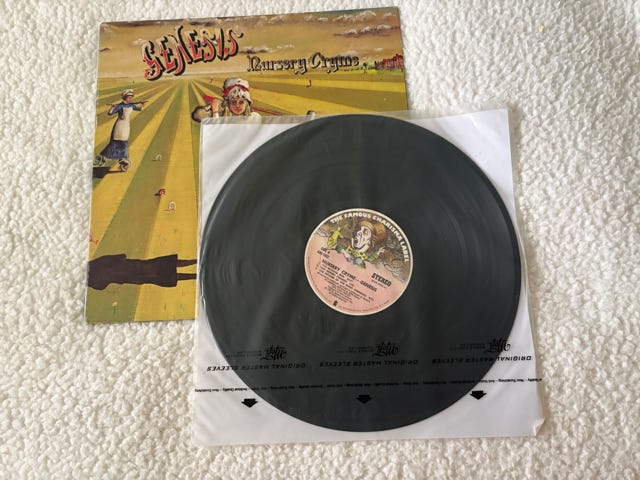
[CharismaLP] was acquired from a Discogs seller in April-May 2024. I decided I needed to hear a first pressing copy of Nursery Cryme after I acquired a similar copy of Selling England By The Pound. This was particularly brought on by a YouTube comment by user @absinthedude that I mentioned in that other article:
I only have two copies of Selling England (both UK first pressings) but I have three of Nursery Cryme. The first I got was in 1990 when I bought a vinyl copy after hearing the CD. Both come from a 1984 remaster which has the aural equivalent of looking through a scene through a film of mud. I bought the 2007 remaster on vinyl which brings out a lot more detail in the high end and tightens the bass but which reduces the dynamic range a LOT. Then I was lucky enough to snag a copy of the original 1971 “pink scroll” pressing on vinyl and it is an absolute revelation. The best of both worlds....the clarity and tight bass of the 07 remaster, and the dynamic range (or indeed better) of the 84 remaster.
This is a “large mad hatter” 1972 United States first pressing, not a 1971 “pink scroll” pressing (similar to the disc art on [CharismaSACD]), but I still hoped for a similar revelation.
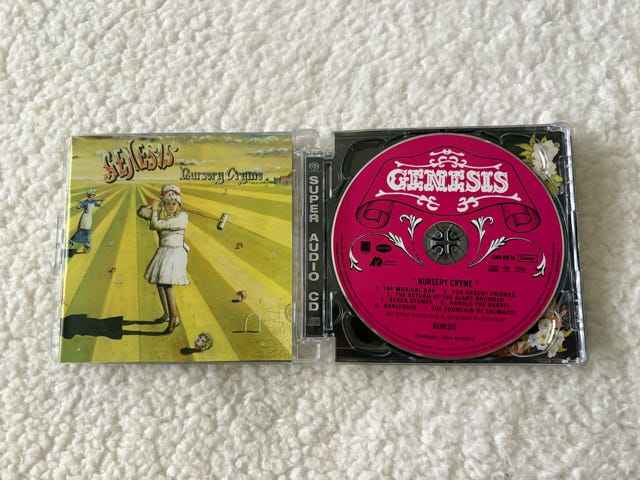
I purchased [AtlanticSACD] in January 2026, immediately upon its release. I’ve liked nearly all the Atlantic 75 Genesis remasters, and I had high hopes for this one as well.
The packaging closely replicates that of [CharismaSACD], except for some differences in song listings (two discs vs one,) production credits (5.1/stereo vs stereo only,) and the artwork on the disc (“Charisma” vs. “Genesis”.) The artwork on [AtlanticSACD] is the most curious. The Selling England By The Pound Atlantic 75 SACD replicated the “large mad hatter” Charisma label. Why isn’t this the regular “pink scroll” label?
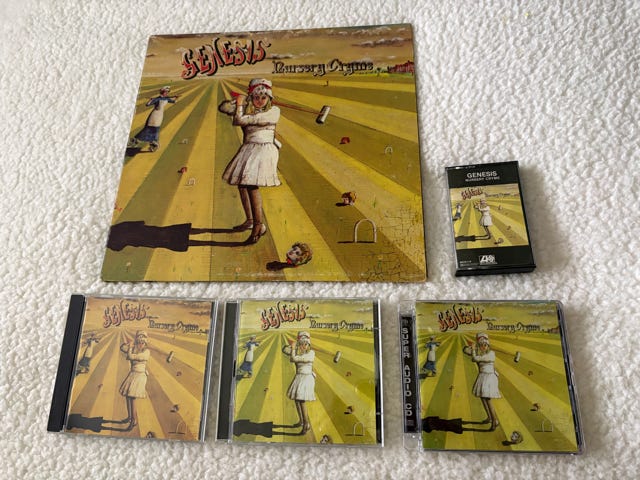
Let me comment on the appearance of these releases before diving into the audio experience. It seems clear that there are multiple color grades of this album artwork. [CharismaLP] and [AtlanticCD] are more sepia-tone in coloration. The other three seem to use a brighter scheme that turns drab into green. From an interview with cover artist Paul Whitehead, that is due to a mistake during the original production process that has only sometimes been reproduced in re-release. As Whitehead states:
When I showed them my original painting, they all said that it didn’t look old enough. They wanted it to look like it came from the Victorian era. So, I varnished the canvas with old honey, and that did the trick. It now had that 19th Century feel to it. But the problem was that when this was sent off to be printed, the first proof which came back had given the painting a yellow hue, which wasn’t supposed to be there. However, we all liked it so much that it was decided to stick with this.
So it appears that [AtlanticCD] chooses to repeat the error from [CharismaLP], and the others use a source that (perhaps) more faithfully reproduces the original painting.
Listening to [AtlanticCAS] on a much more capable Onkyo TA-2058 deck is about as bad as I remember it on a Walkman. There is no soundstage to speak of. The band sounds like it is playing in a closet. There is little in the way of placement of parts. The lower end is present, but indistinct. The upper end is quite rolled off, to the point that Phil’s percussion sounds like it is on the other side of one the closet’s thin walls. That’s with the Dolby B Noise Reduction disengaged. When it’s engaged, hiss goes away but a lot of the upper end disappears with it. Volume level is decent overall, at about that of [CharismaLP]. Playback is just these globs of sound in the mids and upper mids, bringing Tony’s keyboards, Steve’s guitars, and the vocals by Peter and Phil to the fore. Mike’s bass is just present everywhere, and substantially lacking in detail.
Based on that low bar of achievement, [AtlanticCD] is a significant improvement. It brings some genuine soundstage to the party. The band is now playing in a decently-sized room, and there is a much stronger sense of placement of the parts. Additional detail comes with that, across much of the frequency range. Mike’s bass is now a part, along with Steve and Tony. Peter’s lead vocals and Phil’s backing vocals now mesh better with the whole. The one glaring problem is still at the upper end. Cymbals and snares now sound like they might be in the room, though they still are rolled off somewhat. There is a definite sense of ceiling in the playback of this recording, either in terms of frequency or soundstage, that makes keeps the listener reaching to hear that upper end. Volume is louder that [CharismaLP], but not dramatically so.
I would have loved this album a lot more from the beginning if I was listening to [CharismaLP] since 1987. Hearing it evokes a sense of “oh, this is what it’s supposed to sound like” every time I play it. The experience of the music in all its parts is effortless compared to either [AtlanticCAS] and [AtlanticCD]. It’s also got a calm, composed quality compared to [CharismaSACD] as well. Playback is strong across the whole frequency range, with detail and presence everywhere — at least as much as is available on the master tape. There are some signs that the studio and the equipment used by the band are not yet the best. Louder passages seem to especially reveal the limits of the mix, but this is relatively minor. [CharismaLP] is the softest of all the releases.
Listening to [CharismaSACD] side by side with [CharismaLP] reinforces something I’ve always said about the Nick Davis re-mixes: they really benefitted the early albums the most. There aren’t a lot of tracks to play with on these early session tapes and not much in the way of unused material. The two channel stereo re-mixes on this album and Foxtrot sound a lot more like their original counterparts than the mixes of later albums.
This all means that [CharismaSACD] is a dramatic improvement over [AtlanticCD]. All parts are now heard. Now there is also much greater detail and texture. The soundstage is bigger than on [AtlanticLP[, as might be expected. Placement is also razor sharp. The extra detail brings problems though. More of the limitations of the recording process are present. The extra fidelity can reveal rather glass-like qualities of Phil’s cymbals, depending on the DAC used (my Geshelli Labs J2S DAC is better than the DAC in the Onkyo TX-NR636 AVR.) That crystalline quality is present on[CharismaLP] too upon re-listen, but the warmer analog qualities of the recording help hold it in check. [CharismaSACD] is, of course, very loud. It is the loudest of any of the releases, by far. To sample its virtues, be prepared to turn the volume down.
[AtlanticSACD] sets a very happy medium between [CharismaLP] and [CharismaSACD]. Volume level is about the same as the vinyl, and it brings much of the detail and texture found on the other SACD into play. The result is something that’s perhaps a little more neutral or clinical than [CharismaLP]. Some of the warts covered by the warmer, analog sound show a little more in this environment. Yet, it still has some of the easy, effortless quality of the original mix. The choice of whether I prefer analog warmth or digital neutrality tends to vary with my mood.
I think [CharismaLP] is my overall favorite, if I have a turntable nearby. [AtlanticSACD] is a very close second in a photo finish. I will easily reach for that when listening to a digital source. [CharismaSACD] has little wrong with it, aside from the volume and compression. [AtlanticCD] and [AtlanticCAS] are both flawed. The former is an ok listen but no in the same league as the digital recordings and the latter is a historical artifact with little sonic value at this point.