Foxtrot
A comparison of five versions of the album Foxtrot by Genesis starting with first U.S. pressing vinyl and ending with the 2025 Atlantic 75 SACD release.

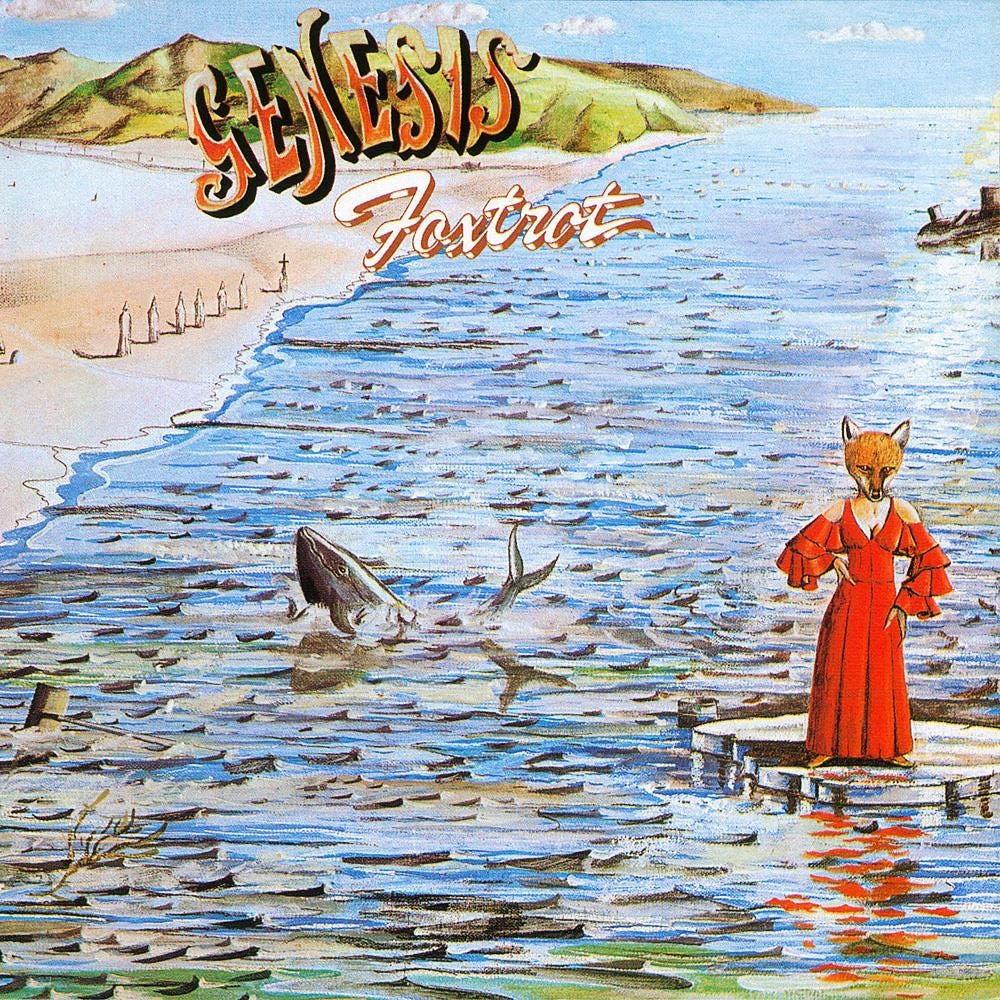
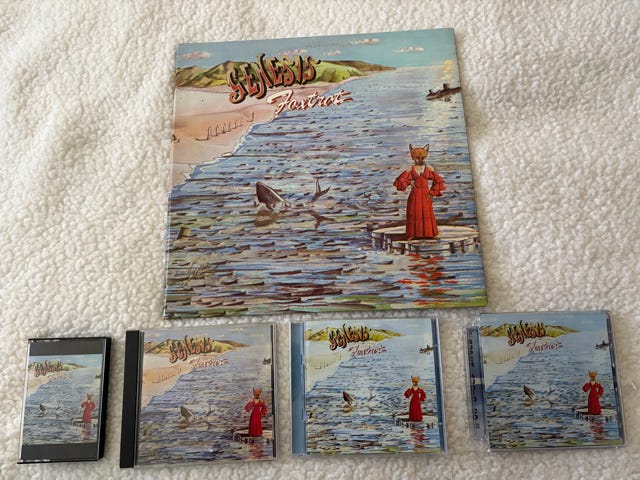
I currently own five versions of the album Foxtrot by Genesis. They are:
the 1972 U.S. vinyl first pressing by Monarch Records from Charisma/Buddah [CharismaLP],
the 1988 U.S. cassette by Allied Recording Co. from Atlantic [AtlanticCAS],
the 1994 U.S. Definitive Edition Remaster compact disc from Atlantic [AtlanticCD],
the 2008 SACD/PAL DVD release of the Nick Davis re-mix/re-master from Charisma [CharismaSACD], and
the 2025 Atlantic 75 SACD remaster by Chris Bellman from Craft/Charisma/Analogue Productions [ATL75SACD]
Released in 1972, this is an album from a band on its way up. Their lineup finally solidified into a strong working unit on their last album, Nursery Cryme. This record builds on that foundation. The band is more aggressive and ambitious. They are more willing to move toward new horizons. This is primarily described by critics such as Stephen Thomas Erlewine as “the first time Genesis attacked like a rock band” in his Allmusic review. Critics generally rate this album strongly for this reason.
I am not quite as ambitious in my assessment. There are some growing pains going on here. While Watcher Of The Skies is very well remembered for its exploration of a science fiction subject (extra-terrestrials visiting Earth after the humans are gone) and its live rumble, its lyrics are rather stiff and overcrowded. This is a sentiment echoed by Mike Rutherford in the band interview on [CharismaSACD]. Time Table is much better lyrically on verses that use rather unspectacular medieval imagery, but the chorus is not the best they ever wrote. For these reasons, the song never completely comes together for me.
Other tracks fare much better. Get ‘Em Out By Friday is easily the best realized song on Side One. It draws on the same humor and social commentary as Harold The Barrel and also explores science fiction ideas like genetic manipulation. Can Utility And The Coastliners is a gem of a deep cut from this album. It draws on a 13th Century anecdote about an 11th Century Viking King of England, Denmark, and Norway, Canute The Great (Canute - Can-Utility, get it?) King Canute demonstrated his humility and piety to sycophantic couriers by commanding the tide to not come in, and failing. It is both lyrically interesting, and ends with a powerful instrumental jam section. Horizons is a beautiful short solo piece by Steve Hackett that makes me wish the featured him and his material more often. Finally, the rest of Side Two is taken up by the epic Supper’s Ready — a song that starts with a passage describing a dream Peter Gabriel had, and ends with a rocking apocalypse that heavily alludes to the Book Of Revelations.
There is some great stuff here. The band has come together and are firing on all cylinders. They’ve also met a long term producing partner. The interview with Tony Banks on [CharismaSACD] all but states that named producer David Hitchcock was hired by the label and didn’t work out. Much of the album was actually co-produced by the band and engineer John Burns — an arrangement that would continue for their next three albums. The only problem is that the band just doesn’t display the kind of total mastery of their music that would shortly become apparent. Foxtrot has plenty of charm and a rough and ready energy that is hard to ignore, however. The band aims very high, and they grow stronger and wiser for the attempt when they miss.
This album and I have history. It begins, I suppose, with the fact that it and the band’s next release, Genesis Live, were not widely available in the United States when I became a fan in the 1980’s. Charisma released the album in the United States with Buddah Records as distributor in 1972. That distribution contract was picked up by Atlantic Records in 1973 for Selling England By The Pound and the band was signed to Atlantic’s ATCO division for The Lamb in 1974. Somehow, Atlantic re-issued Selling England By The Pound as a proper Atlantic album in 1980 and Nursery Cryme on vinyl LP and cassette, as early as 1982. Foxtrot and Live did not get a proper Atlantic re-issue on LP and tape until 1988, when the first CD editions came out.
I first became aware of this hole in the Genesis catalog in about 1987, when I got the band’s second live album, Seconds Out. One whole side of the double album was devoted to Phil Collins singing Supper’s Ready and I became obsessed with the song. I had pretty much every album on cassette (except The Lamb) going all the way back to Trespass, at least. Where did it come from?
My first clue came from a German pressing of a compilation LP called Rock Theatre.
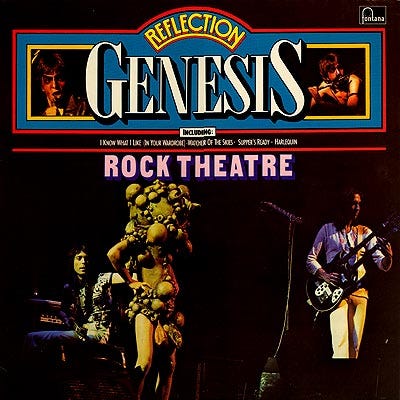
I found a used copy of this record sometime in late 1987. Aside from the marvelous picture of Peter Gabriel in a Slipperman costume on the cover, the track listing had one song on Side One that was completely unfamiliar (Watcher Of The Skies — the 3m:46s single version!) and Supper’s Ready taking up all of Side Two. I snapped it up immediately and heard the studio version of Supper’s Ready for the first time. After hearing only the live version, I suppose I was a little surprised how stiff the studio version sounded… and how Phil had changed a few of the lyrics.
My next step in this journey came a few months later in the discount tape bin at my favorite local record store. I discovered a cassette that was at once both familiar and unfamiliar with notations written in Spanish:
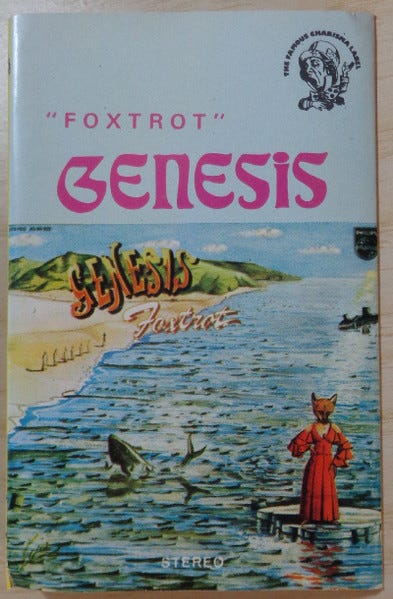
Upon purchase, I discovered that this was a Spanish-made cassette of an album called Foxtrot from Charisma Records (the first time ever heard that name!) Checking the song list, I immediately saw both the names from the Rock Theatre LP. This was the origin of Supper’s Ready!
Unfortunately, understanding of that origin was about the only thing I had. The tape itself sounded horrible. Though the Rock Theatre LP was far from perfect, I remember little about this cassette but rolled off highs and wow and flutter. This kind of poisoned my attitude towards this album for a time. I only saw the flaws. Some of the lyrics are quite stiff, as I already noted. There are also technical issues. The most noticeable is the the tape join between the Willow Farm and Apocalypse in 9/8 sections of Supper’s Ready. A single chord sits at both sides of the join, and there is an interruption that is rather jarring. The sonics, the production errors, and the lyrics all kept this album from quite coming together for me.
I don’t know where either the Rock Theatre LP or the Spanish cassette are now. I was living with my parents in the late 1980’s. I strongly suspect that the LP is still in my parents’ house. The cassette may be too, though I would not be surprised if I threw it away.


I found a better copy of the album in either 1988 or 1989 when [AtlanticCAS] came out. This is a much better version of the album. Like Abacab, it’s got proper liner notes (though no lyrics) but it was a modern master duplicated with Dolby HX Pro noise reduction.
The cassette did not get a lot of play, however. I was glad I had proper copies of Foxtrot and Live to document the full band history, but my experiences with the Spanish cassette left me feeling ambivalent. This was part of the band’s history not much celebrated later in the United States, and I felt content to see it as something of an artistic backwater. I never purchased a copy of the original 1988 compact disc.
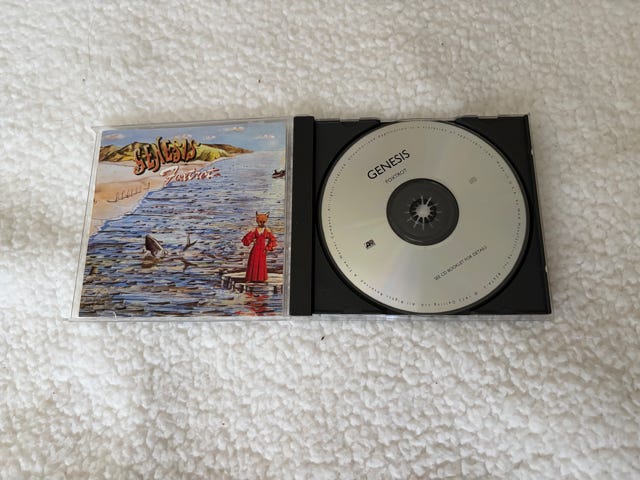
This album next crossed my path when [AtlanticCD] came out in 1994. Here again, I got the Definitive Edition Remaster in 1994 or 1995 out of a sense of completeness as much as anything else. This disc did help rehabilitate my attitude toward the album somewhat. I finally had the sense that this was a solid album, but not one that I recall listening to regularly.
I liked the packaging that came with this disc. Though [AtlanticCAS] was far from shabby, it was nice to finally have lyrics. The booklet does skip over the artwork in the gatefold of [CharismaLP], however.
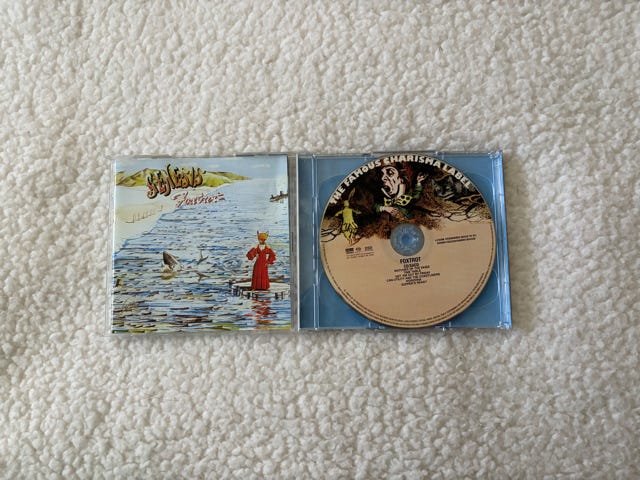
The Nick Davis re-mix on [CharismaSACD] was where my opinion of Foxtrot finally began to turn. I don’t remember exactly when I got his disc, but it has the PAL DVD. That means probably at least 2011 or 2012. Davis’ work on Foxtrot and Nursery Cryme opened both of those albums up for me. The passage of time and the overpowering clarity of the SACD release finally dispelled any bad memories I might have had from the late 1980’s. Erlewine’s Allmusic review of Foxtrot also helped underline why it’s an important album.
The booklet here more faithfully reproduces the gatefold from [CharismaLP]. Lyrics for each song sit on reproductions of the upper part of the gatefold artwork, and liner notes and credits sit on the full artwork.
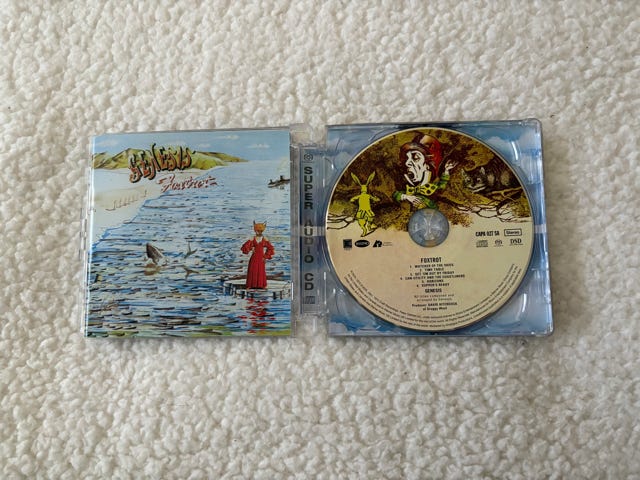
I ordered [ATL75SACD] from Acoustic Sounds on the day that it dropped. It arrived about a week later in early August.
The booklet here more or less reproduces the booklet from [CharismaSACD], with the exception of some font changes (in song titles) and alterations to liner notes (no DVD to cover.)
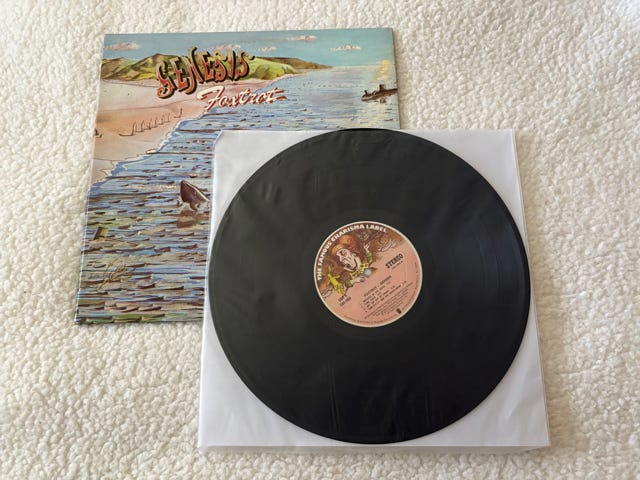
[CharismaLP] is a purchase from Discogs. It’s a very clean U.S. first pressing that came from two states away for more money than I ideally wanted. There are one or two visible scuffs at the beginning of Side Two that do not appear to be audible.
I did this before checking the local record store, where I probably would have paid about $15 less. While [CharismaLP] was in transit, I swung by the store to play “what if”. There was a nice early German pressing copy, though I didn’t check if it was clean. I’m satisfied with the Discogs purchase.
When it comes to sound, I wish I heard this album first on [CharismaLP]. The experience would have been so very much better. The music is clear and represents frequencies well across the whole range from deep, almost pressure wave bass to cymbal crashes at the high end. It is not quite as resolving as some other releases, but generally good to excellent. Soundstage is not heavily developed, with the band quite in close and in front of the listener. Part placement is relatively distinct, but it all sounds close together in mostly a left to right sense. There definitely seems to be some sense of ceiling to loudness and intensity, and the music seems to strain a little on the more dramatic crescendos. [CharismaLP] is soft, though not the softest release (for once.) There is some surface rumble on the softest passages the music, though it is generally not bothersome.
I had high hopes for listening to [AtlanticCAS]. Unlike so many of the other tapes in my collection, this one was mastered at the height of the Walkman era, when tape sales ruled. Attention was hopefully paid to its production. I also didn’t play it much back in the day, so it likely would not trashed from wear. I want to have at least one tape from my Walkman era that stacks up pretty well to other releases.
[AtlanticCAS] did not disappoint and was something of a surprise. The really standout quality of the recording is the soundstage. Parts sounded relatively well-placed, with significant air between them. Frequency reproduction was not as good as [CharismaLP], but generally respectable. The overall profile has a bit of a smile shape to it; both the lowest of lows and some of the highs reproduced well. What tended to miss was some of the mids, generally Tony’s keyboards and Steve’s guitars. It’s a noticeable difference, but not awful. Percussion tended to sound a little crystalline with a little muddying sibilance. [AtlanticCAS] is actually quieter than [CharismaLP] as far as I can tell by ear. Mastered quieter than vinyl: how about that!
[AtlanticCD] is takes two steps forward and one step back from [CharismaLP] and [AtlanticCAS]. The first thing you notice is the soundstage. It’s wall of sound. The band are right in front of the listener and parts are all packed close together. The ceiling that [CharismaLP] presents is gone; the recording does not seem to push against the limits of the medium. The sibilance from [AtlnaticCAS] is gone, but some of that metallic, crystalline quality remains. The mid-frequencies are fully represented. Volume level is slightly louder than [CharismaLP] but the change is not annoying.
[CharismaSACD] fixes a lot on this album, for both good and bad. The good is that with the re-mix the awkward tape splice in the middle of Supper’s Ready is now completely smooth. Davis also plays with part placement in the soundstage in interesting way. Parts move as songs progress, sometimes in ways that pair well with the music. The bad is that this record now loses a little of its rough and ready quality. This is an album from 1972, not 1982. As someone who came of age in the 1980’s listening to music from the 1970’s, I don’t expect sonic perfection. I really appreciated the clarity of the music when this disc came out. I thought I was hearing it washed clean of a layer of grime for the first time. Hearing [CharismaLP] over a decade later bears that feeling out to a large degree, but I think it ultimately goes a little too far. Like all the Davis re-issues, it’s also terribly loud with a very large soundstage. There are no surprises in that regard.
I found [ATL75SACD] to be fairly revelatory. I heard it and thought, “wow, this is what it should sound like.” It takes the sonic profile of [CharismaLP] and strips away the ceiling, adds texture to the parts, and adds (some) placement in the soundstage. This is the original mix as about as good as it can be, I think. It doesn’t have all the air between parts that [AtlanticCAS] has, but it has excellent reproduction across the full range that integrates the music together in ways that only [CharismaLP] (almost) does. It is full, without being [AtlanticCD]’s wall of sound. Clarity is excellent, which brings Phil’s percussion parts out in ways that most releases do not. That has the down side that the Supper’s Ready splice sounds as clear and awkward as ever, but that is a wart of history. It is also very clearly a recording of its time, with none of its essence restored away. Volume level is a little louder than [CharismaLP], but not much.
I think [ATL75SACD] is the best overall release of the album. [CharismaLP] comes close, but the new SACD is more dimensional and revealing. [CharismaSACD] comes in behind those two, not because it’s bad but rather because I don’t think Davis’ changes suit the music. I wish [ATL75SACD] had a few of Davis’ fixes, but not all of them. For the last two, I’ll pick [AtlanticCAS] over [AtlanticCD]. The cassette has the better soundstage. For all its fidelity, the wall of sound on [AtlanticCD] is a lot to take.